
Agentic SOC: The Future of AI-Powered Cybersecurity

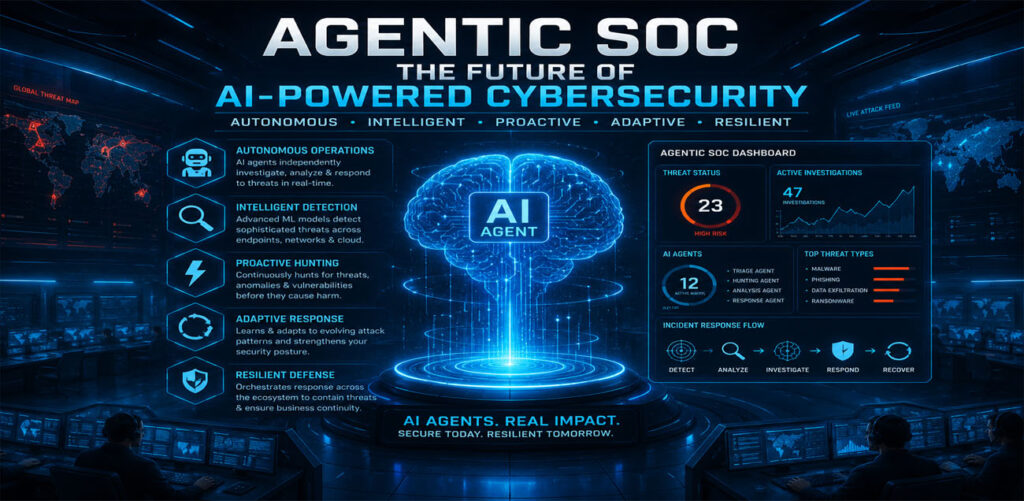
Cybersecurity threats continue to increase in complexity, occurrence, and challenges associated with their management. Conventional security operations centers (SOCs) rely on human intervention to handle alerts, conduct investigations into malicious activities, and address the threats. However, this system continues to be effective despite the ever-increasing amounts of security information.
Here, an Agentic SOC comes in handy since it makes use of artificial intelligence, automation, machine learning, and autonomous AI agents to address cybersecurity threats.
What Is an Agentic SOC?
The Agentic SOC is a contemporary security operations approach that employs AI agents in carrying out cybersecurity activities with substantial autonomy. AI agents are not just able to detect possible security risks but are also capable of analyzing data, making decisions in accordance with predefined goals and policy guidelines, and acting accordingly.
Whereas traditional security systems usually provide security personnel with alerts to be investigated, the Agentic SOC enables AI agents to correlate data from various sources, comprehend the context of the security event, evaluate risks, and take action.
The objective is not to replace human security personnel altogether but rather to free security analysts from repetitive tasks.
More Read: FASHION Magazine
How Does an Agentic SOC Work?
An Agentic SOC combines multiple technologies and processes to create a more responsive security environment.
1. Data Collection
Step one is the collection of security data through various sources. The sources may comprise endpoints, servers, clouds, applications, firewalls, identities and networks.
AI agents can then analyze this data in real-time in order to determine anomalies or possible security threats.
2. Threat Detection
AI-based systems can detect patterns that may suggest the presence of any attack. For instance, strange logins, file behavior, network traffic, or privilege alterations may set off an investigation process. Machine learning can aid in the detection of both existing and new patterns of attacks.
3. Investigation and Contextual Analysis
Every security alert is not necessarily a major threat. The security team may be swamped by many alerts without any context.
An Agentic SOC can cross-reference the information gathered from various security tools and establish if there is any correlation between the events.
4. Automated Response
Once the threat is identified, the artificial intelligence agent can carry out pre-determined steps to counter the identified risk. These actions can take different forms based on organizational guidelines, and can include quarantining an endpoint, stopping any unusual traffic from occurring over the network, or taking down a breached account.
The organization can set the conditions for human intervention during these actions.
More Read: Top Stories
Key Benefits of an Agentic SOC
Faster Threat Detection
Security breaches can happen rapidly. It is possible that with delayed discovery, the attacker will gain more time within the environment or to obtain any sensitive data.
Agentic SOC is capable of analyzing security events continuously and much quicker than any other manual methods.
Reduced Alert Fatigue
Security analysts tend to spend considerable time analyzing repeat or low-priority alerts. AI agents will be useful in prioritizing and sorting through these alerts based on risk and context.
Security analysts will be able to focus on cases that need further analysis.
Improved Response Times
Automation of workflows can save time between threat detection and action taken. Rather than waiting until all responses have been done manually one after another, the action approved by the system can be taken.
Faster response is a means to control the effects of cybersecurity threats.
24/7 Security Operations
A cyberattack can happen anytime. This is where an Agentic SOC will have the ability to constantly monitor the security environment regardless of time constraints that come with traditional workdays.
The organization gets another level of security cover in the night time, weekend, and holidays.
Better Use of Security Teams
Cybersecurity personnel are in great need, and there is often a lack of staffing in numerous companies. Agentic SOC systems are able to automatize routine processes and assist in dealing with increased workload.
Thus, human staff will have the opportunity to engage in searching for threats, complicated investigation, planning, and management of incidents.
Agentic SOC vs. Traditional SOC
SOC usually requires many security analysts to investigate the alerts generated and make decisions regarding the next course of action. Many tools such as SIEM, EDR and others provide valuable insights, but the task of linking those pieces of data is often performed by humans.
An Agentic SOC uses AI agents for that purpose.
| Traditional SOC | Agentic SOC |
| Heavy reliance on manual analysis | AI-assisted and autonomous analysis |
| Large volumes of alerts | Intelligent alert prioritization |
| Manual investigation workflows | Automated investigation workflows |
| Human-driven response | Automated or AI-assisted response |
| Reactive processes | More proactive and continuous operations |
The right approach depends on the organization’s security requirements, risk tolerance, infrastructure, and governance policies. In many cases, the most effective model will combine AI capabilities with human expertise.
Important Use Cases for Agentic SOC
Several cybersecurity tasks can be enabled by the use of agentic SOC technology.
- Threat investigation: AI agents could collect information across various security platforms to obtain a more comprehensive understanding of an incident.
- Incident response: It is possible to automate certain responses to particular threats that have been detected.
- Threat hunting: Using agentic systems, it will be possible to scan large amounts of data in order to detect any anomalies that might not be detected using rule-based systems.
- Identity security: Agentic systems could monitor anomalies in the way logins take place, privilege escalation, and other related activities.
- Cloud security: Agentic systems could monitor cloud environments for configuration issues and anomalies.
Challenges of Implementing an Agentic SOC
Despite its advantages, an Agentic SOC also introduces challenges.
- Trust and Accuracy:- AI systems can make incorrect assessments. Organizations need processes to validate AI-generated decisions and reduce the risk of inappropriate actions.
- Human Oversight:- Highly sensitive cybersecurity actions should not always happen without approval. Organizations should define which activities AI can perform independently and which require human authorization.
- Data Privacy:- Agentic SOC systems may process large amounts of sensitive security information. Companies must ensure that data is handled according to applicable privacy, security, and compliance requirements.
- Integration:- An Agentic SOC may need to work with existing SIEM, EDR, identity, cloud, and network security tools. Poor integration can reduce the effectiveness of automation.
- Governance:- Organizations should establish clear policies around AI permissions, audit logs, decision-making, escalation, and accountability.
More Read: Featured
The Future of Agentic SOC
Future developments in cybersecurity are expected to see greater integration between man and artificial intelligence. AI can undertake routine security monitoring, investigation, and response functions while cybersecurity experts offer strategic guidance and tackle complicated situations.
With advances in artificial intelligence, the Agentic SOC platform would develop its capability to analyze security context, coordinate security tools, and adapt to the threats.
But success in this area cannot rely solely on technological innovation. Companies will need proper governance, security data, permissions, and professionals who understand how to manage the process.
If you are looking for Agentic SOC services, we provide AI-powered security solutions designed to help businesses detect, investigate, and respond to cyber threats faster. Our Agentic SOC services combine intelligent automation, continuous monitoring, and advanced threat detection to strengthen your security operations and reduce response times.
More Read: Blog
Conclusion
An agentic SOC is one of the significant advancements made in cybersecurity through the use of AI. The combination of intelligent agents with security technologies, automation, and human knowledge can help detect threats, reduce alert fatigue, speed up incident response, and strengthen overall security operations.
Instead of substituting the roles of cybersecurity experts, an Agentic SOC can work as a force multiplier. This is because such a SOC can carry out tasks that are routine and time consuming while focusing on other important tasks.
With evolving cyber threats, companies that leverage AI technology for cybersecurity can have an advantage.
Might You Also Like: Types of Follow-Up Care Bicycle Accident Victims May Require





Responses